Město Kyjov
In your pocket and on the streets - the city closer to its citizens


The city website is no longer just a digital bulletin board. The city of Kyjov realized this and decided to invest in informing its citizens. Our task was to transform the original, complex and confusing presentation into a solution that radically simplifies the path to information and frees administrators from content management. The result is a functional and fully responsive website where residents can find important news in a few clicks. Take a look under the hood of our process – from data analysis to moments when our work went beyond monitors and helped the city in its physical world.
The services we provided
Kyjov Town
Kyjov administers an administrative district of 42 municipalities with 55,000 inhabitants and also cares for the cultural identity of the region – from the international Concentus Moraviae festival to the traditional Fašaňk carnival. For a town that serves such a wide range of people, the website is no longer just a presentation but has become a key piece of infrastructure.
Original website
The initial impulse to implement a new website was the critical need for a fundamental systemic change. The original digital presentation of the city was an example of poor data structures, where any action was complicated by unclear orientation and technological obsolescence. Demanding data management and maintenance unnecessarily made the work of the management and website administrators more difficult, while citizens encountered duplicate content and lack of clarity, which also hindered information. Without proper optimization for mobile devices and with a design that no longer met aesthetic or functional standards, the website ceased to serve its purpose.
Project goals
We consulted with the guarantors of individual departments and citizens during personal workshops about all the shortcomings of the original solution. By summarizing the requirements, a clear task emerged: to build a system that would represent Kyjov as a modern and open city. The main priorities included:
- User-friendliness: create intuitive navigation and a clear information structure, thanks to which all content is available with one click.
- Efficient administration and development: simplify administrative work for officials and prepare the system for easy integration of future digital services.
- Responsiveness and visual clarity: design a modern design that ensures full functionality on all types of devices and supports easy scannability of text for quick user orientation.
Methodology
The project ran from January to December 2023, when it was symbolically launched with the arrival of the new year. The total duration of implementation was 12 months. A team of six experts worked on the project, the website contains over 20 templates and integrates several external systems.
Development process and technical implementation
We chose an agile approach to develop the project, which allowed us to flexibly respond to the needs of the city and continuously fine-tune the details based on feedback from the client and citizens. The entire process was divided into five key stages:
- Analysis and wireframes: First, we deciphered the requirements of the office and citizens and created a "skeleton" of the website (wireframes) to clarify the logic and structure of the information.
- Prototyping: We designed an interactive model, thanks to which the city could "touch" and test the website before the first line of code was written.
- Template design and coding: We translated the approved graphic designs into clean code according to the "Mobile First" principle. This ensured that the website loads quickly and looks great, especially on mobile devices, which are a priority for citizens.
- Deployment on CMS Jarvis: We connected the finished templates with our Jarvis content management system. We set up intuitive modules so that officials could easily manage content and upload documents without the help of a programmer.
- Testing and integration: We connected the website to city databases and social networks. Before launching, we thoroughly tested everything for security and speed on all types of devices.
The implementation itself placed great emphasis on user-friendliness. The coding was carried out using modern technologies that support the stability and easy maintenance of the system. A crucial step was the involvement of beta testers from among real users. Their valuable feedback allowed us to fine-tune the details of the website control so that it was intuitive and understandable for every citizen of Kyjov. The result is a lively, interconnected system that presents the most up-to-date information in a modern and secure environment.
Used technologies
The website is based on the Nette PHP framework — we chose it deliberately for its strong security architecture, which is crucial for a public institution's website, and for its native support for modularity, which facilitates future expansion without interfering with the core of the system. The Jarvis content management system is our own solution designed specifically for the needs of cities and municipalities — unlike generic CMSs, officials do not need any technical knowledge, and all content management is done through a clear interface. The visual layer built on Tailwind CSS ensured design consistency across all 16 templates while maintaining loading speed — the mobile version achieves a Lighthouse performance score of over 90 points.
Team and roles of individual members
The success of the project was ensured by a well-coordinated team of experts, each of whom brought their specific know-how to Kyjov. The project manager ensured smooth communication with the city and adherence to the schedule, while the UX designer and graphic designer focused on ergonomics and the visual identity that represents the city. The technical implementation was handled by the coder and programmer, who transformed the graphic designs into functional code and connected them to the dynamic elements of the system. To make the website truly useful for citizens, the content manager oversaw the logical structure of the texts and their optimization, while the tester subjected each part of the website to strict checks on different types of devices, thus guaranteeing a flawless user experience.
Design and functionality
Data analysis and traffic
To build the website on a solid foundation, we started with thorough research. Between December 2022 and January 2023, we analyzed user behavior, consulted with office employees, and reviewed competing projects.
Thanks to this, we identified the most visited pages, such as the main page, the "I need to get done" section, the city office, personal documents, electronic ordering, leisure and tourism, event calendar, documents, city life, and the office's departments. A look at the traffic analysis confirmed that people definitely go to the website - 47.6% were direct accesses and 45.9% were search engines, while social networks (2.9%) were only marginal.
However, the strongest argument for a radical change in design was the method of access. A whopping 82.13% of visitors came from mobile phones, while only 17.02% used desktops and 1.8% used tablets. These numbers were a clear indicator of which priority devices to focus on when implementing the website. They helped us precisely define the menu structure and prioritize the most important pages so that the most sought-after tasks were immediately available.
Key result
+131 %
growth of desktop users one year after launch
Mobile engagement
69,3 %
growth of desktop users one year after launch
Desktop efficiency
- 18 %
shorter time searching for information on the desktop
Tablet connection time
+ 35 %
tablet users spend significantly more time on the web
The most effective website structure
To verify that the new layout would actually work, we created user scenarios that revealed the weaknesses of the original website.
A typical example is the story of painter Petr, who wants to start a business after completing his apprenticeship. In the original structure, Petr would have to wander through the “Need to do” section and then search through confusing lists of links in “Business”. The new structure offers him a shortcut – via “Quick access links” on the main page, he can go directly to the “Business, Self-Employed” section, where he will immediately find “Establishment of a trade license”.
Similarly, Dagmar, a businesswoman who runs a flower shop on the square and needs to park in front of her shop every day, no longer has to search for a parking card under the vague term "Road Management", to which she would click through "I need to get it done" and "Transport and drivers". The new menu leads her directly through the "Transport and drivers" link to the "Parking cards" section.
Based on these findings, we designed a new information architecture for the main menu, which is divided into thematic sections:
- About Kyjov: newspapers, news, webcams
- I need to get it done: personal documents, fees, transport, business, housing, education
- City and office: city office, city, city police, official board
- Leisure: sports, culture, information center, bicycle rental and storage
- Contact: office hours, quick connection
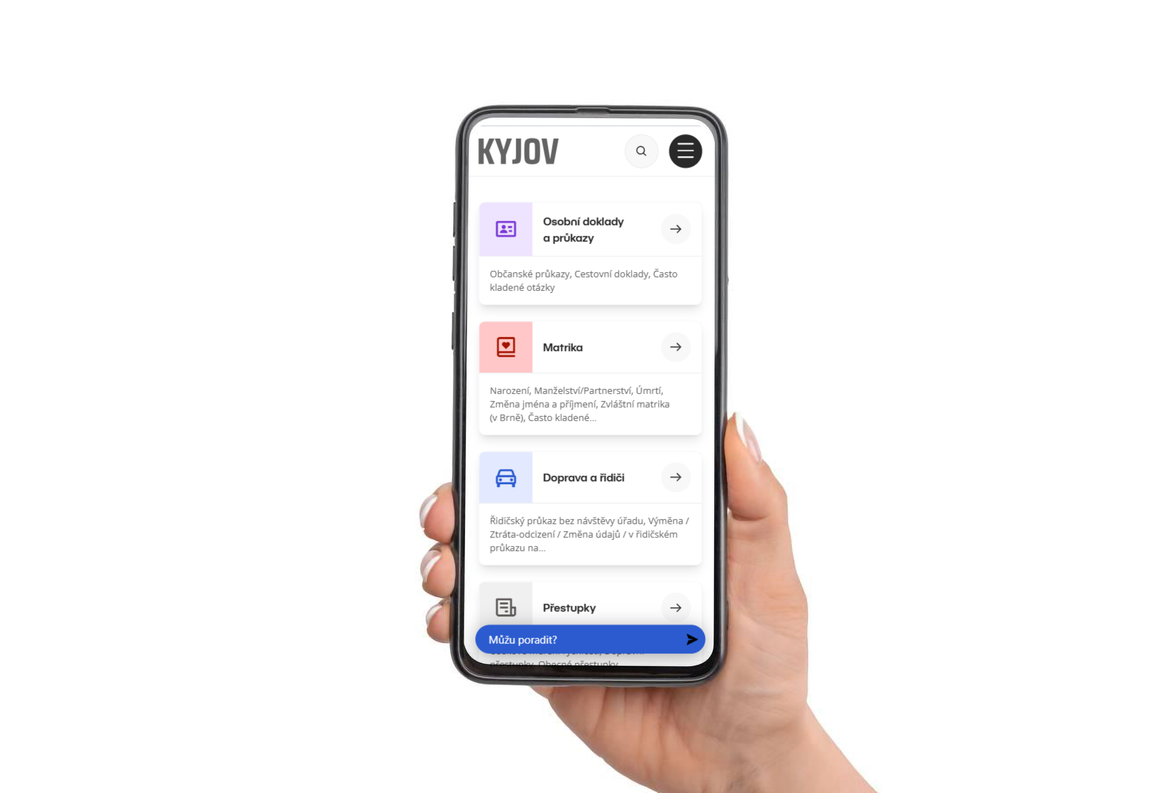
To make navigation on mobile devices as easy as possible, we worked with a variant of the single-level main menu structure, which is attached below for your reference. It radically simplifies orientation because the user sees everything important right away.
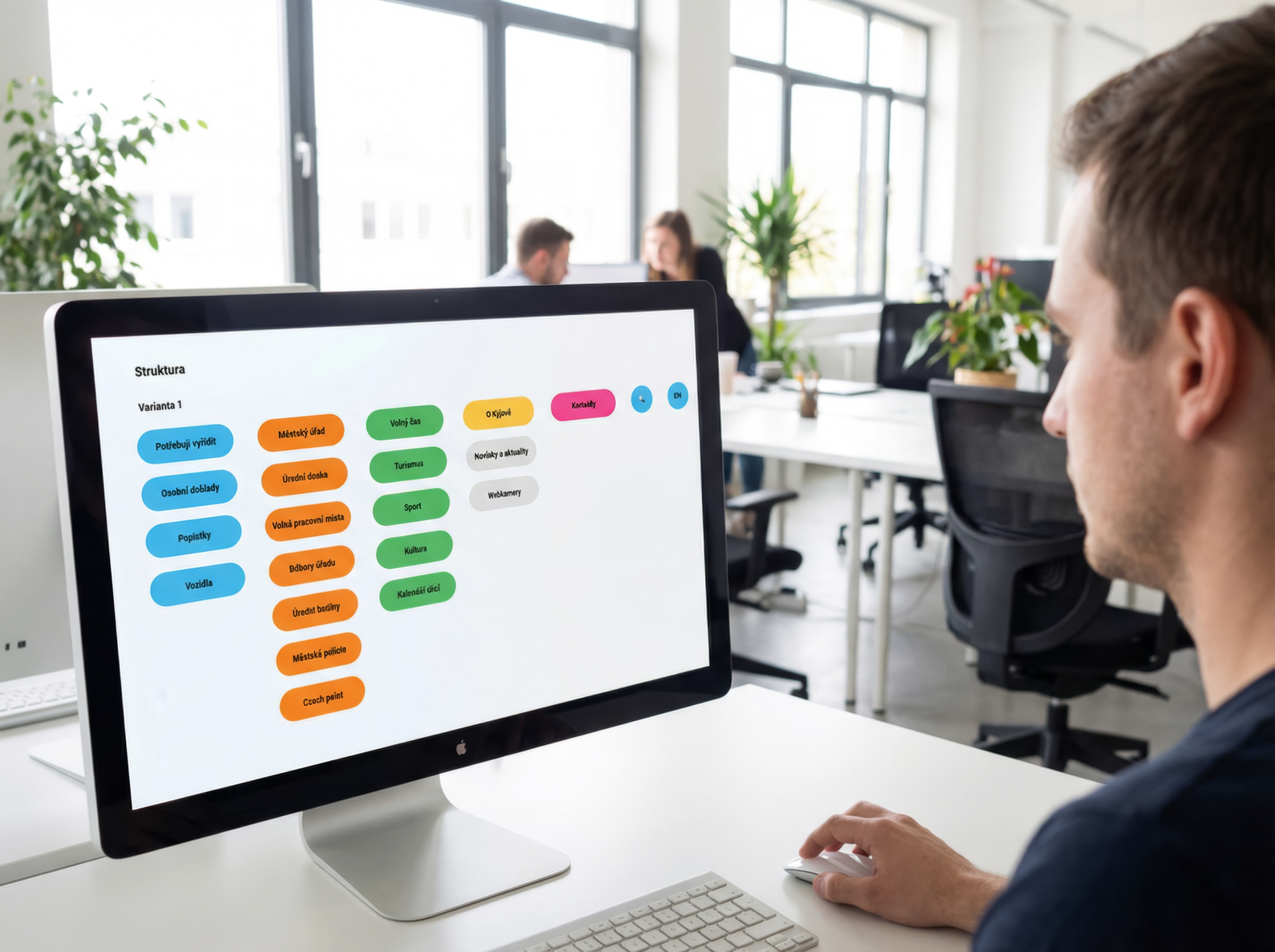
The entire process from wireframes to interactive prototypes was thus directed towards a single goal: to create a modern interface that does not delay the user, but accompanies them.
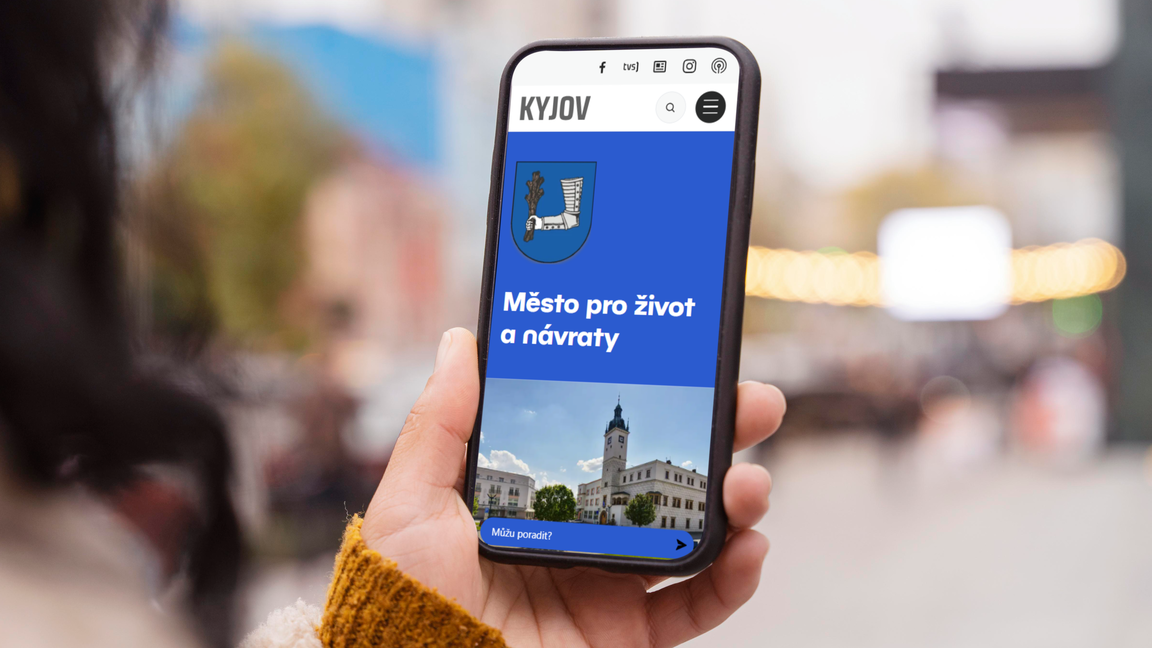
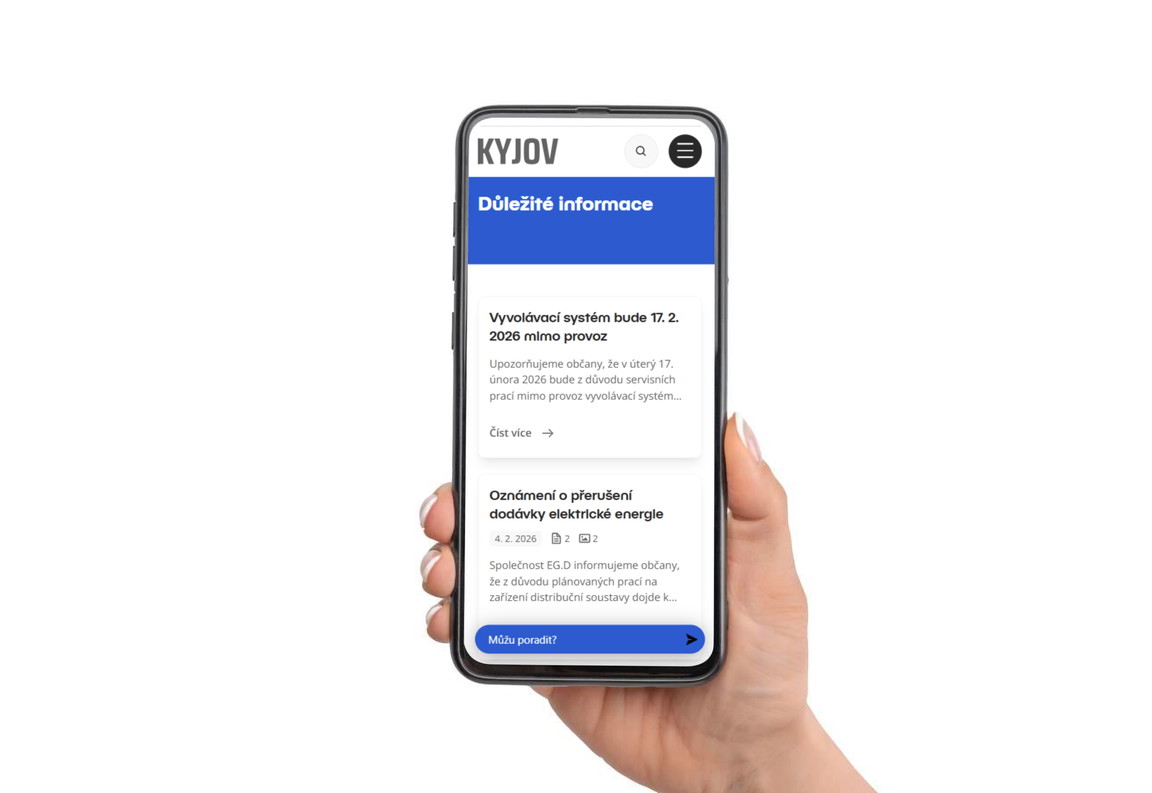
The home page is an imaginary gateway - its task is to immediately attract the visitor, clearly present the identity of Kyjov and motivate them to further explore the content. Therefore, when designing it, we placed maximum emphasis on visual attractiveness and a clear hierarchy of information. The main page currently functions as an effective signpost: it offers an overview of the most visited links for quickly handling official matters, displays the most important news from the city police, invites you to future events in the calendar and presents life in the city through a photo gallery.
To make the website consistent and clear in every corner, we defined a set of 16 unique templates that cover all content in a structured way. In addition to the representative home page, we designed specific category listings, such as the key section "I need to get something done", which functions as an intuitive signpost for practical information. We also kept in mind the diversity of content – from classic news with preview images to text templates for official documents. The entire system is complemented by templates for multimedia galleries, clear contacts, a digital bulletin board and an events calendar. We also emphasized the functionality of search results so that the path to information is always as short as possible.
This modular template system allowed us to create an environment that is visually clean and modern on the one hand, but technically ready to accommodate a huge amount of diverse information, without compromising user-friendliness.
Accessibility and compliance with the law
As a public institution website, mestokyjov.cz must comply with the requirements of Act No. 99/2019 Coll. on website accessibility, which is based on the WCAG 2.1 standard at the AA level. We have adapted the entire design system to this: color contrasts meet the minimum ratio of 4.5:1, all interactive elements can be controlled by keyboard, images have alternative text descriptions, and forms are readable by screen readers. The website underwent an accessibility audit before and after its launch.
Key Features
The new Kyjov website is not just about information, but about interaction and making everyday life easier. We have implemented a number of smart features that bridge the gap between the digital world and reality. The most important ones include:

Dynamic online forms
They allow citizens to process applications directly from home, eliminating the need to physically visit the office.

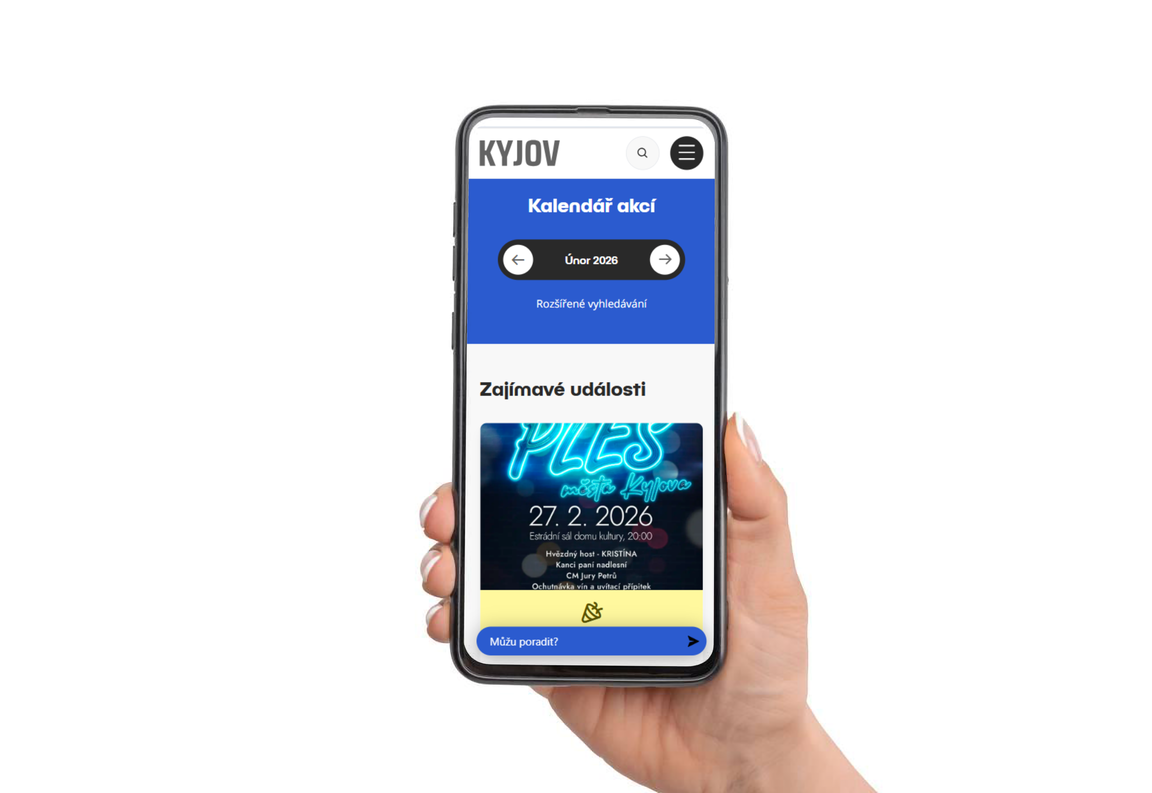
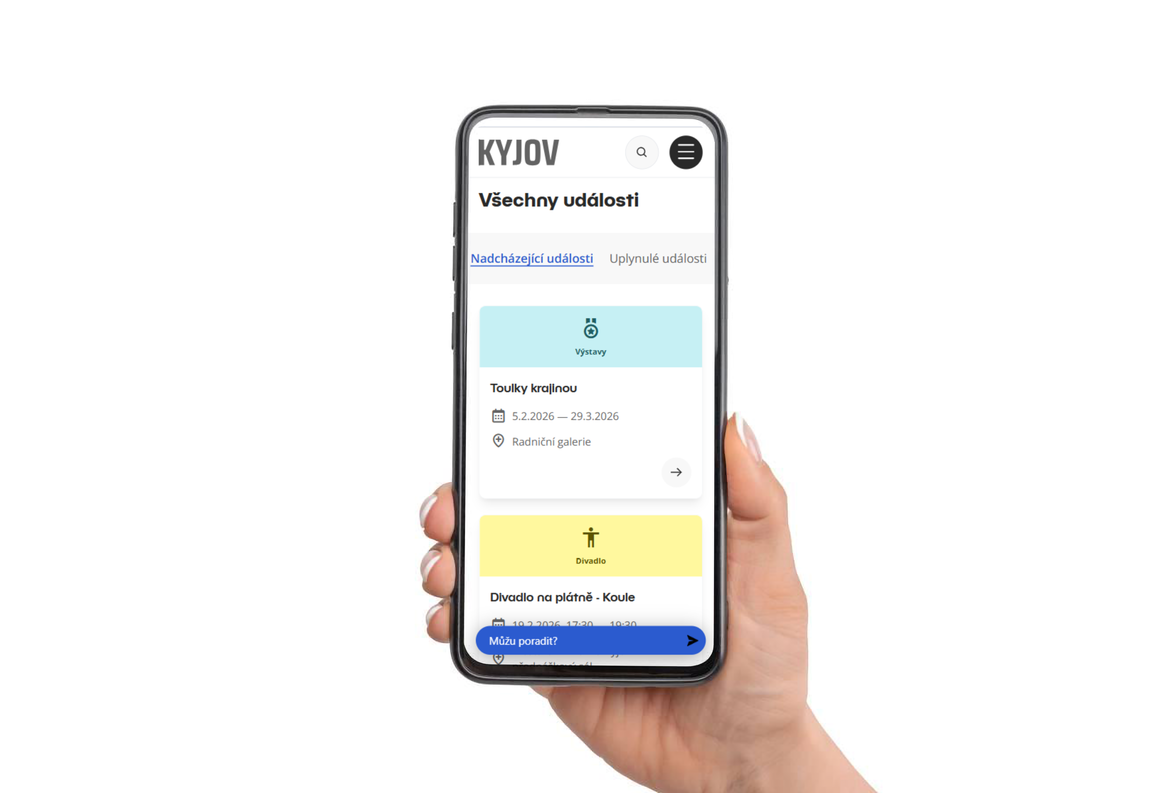
Smart calendar with import
Every event or cultural event can be saved directly to your mobile phone calendar with one click.

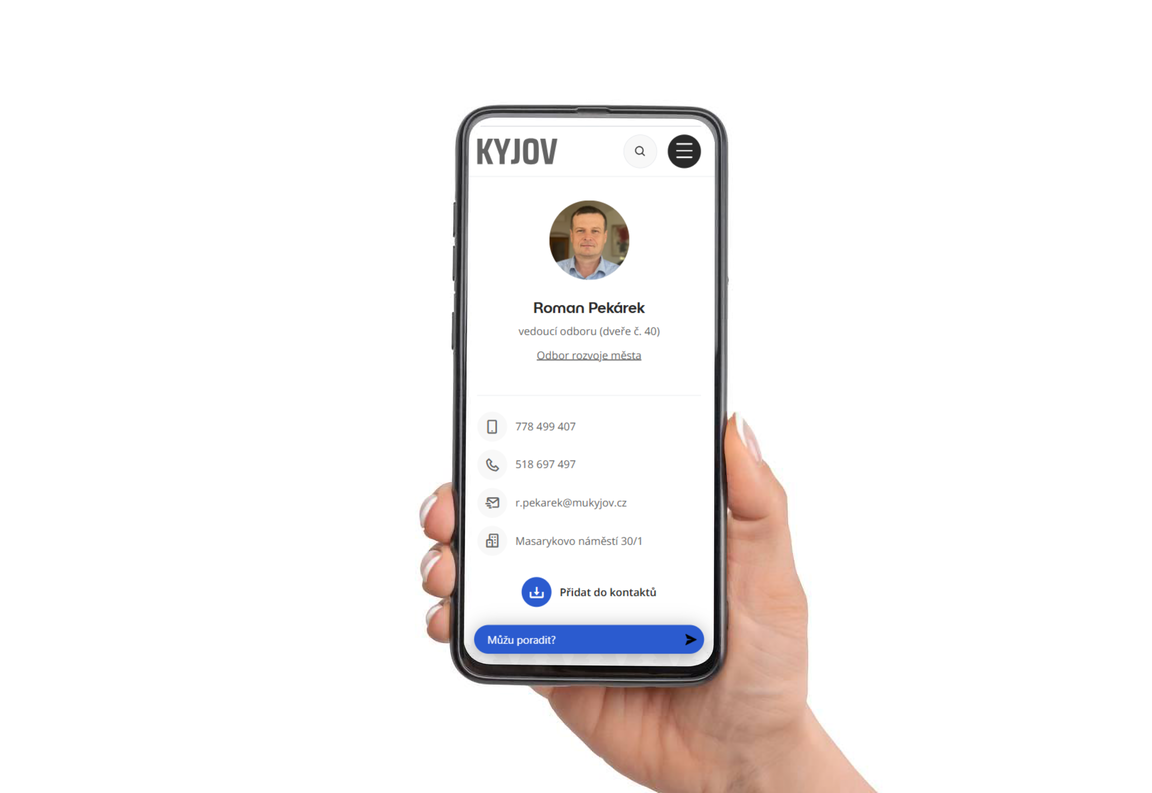
Digital employee business cards
Contacts for specific officials can be downloaded in vCard format directly to the mobile directory, including links to their departments and office hours.

Full-text search
A powerful search engine that instantly finds documents, contacts, and news across the entire web.

Contextual coherence
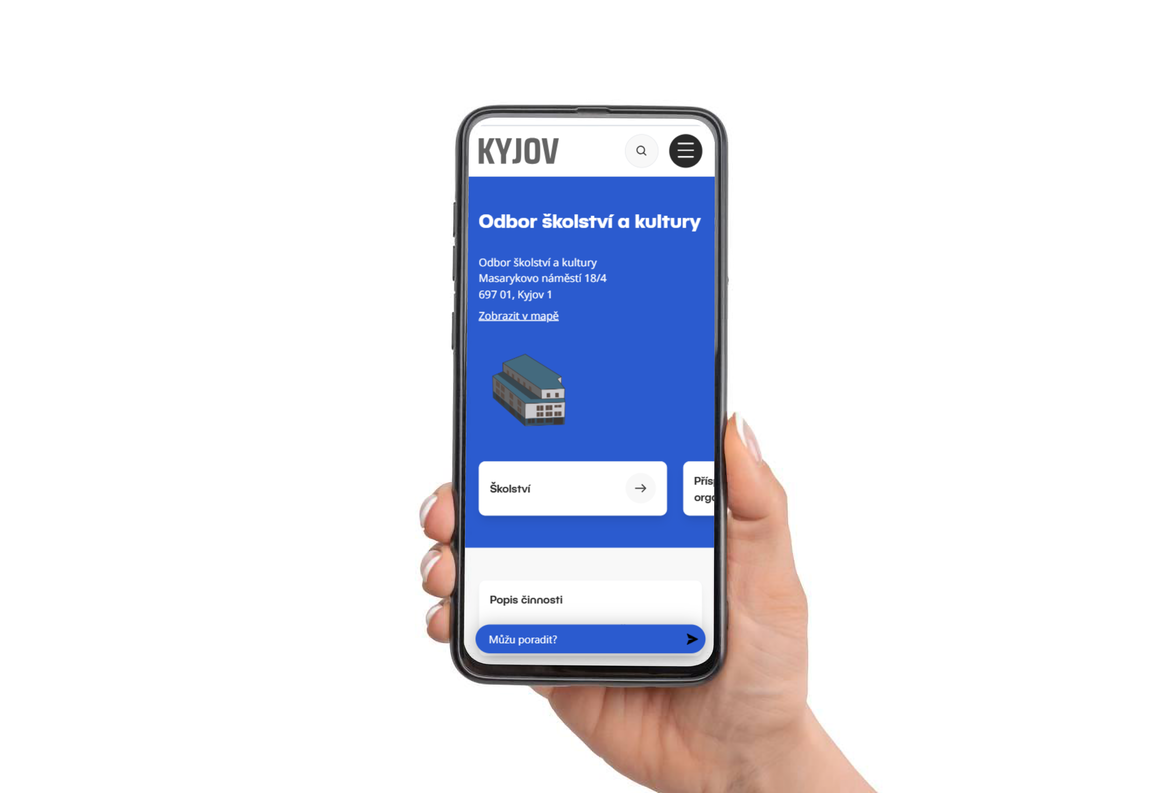
No piece of information stands alone – for each article, the user immediately sees the person responsible, a map of the workplace, and relevant contacts.

Newsletter subscription module
An automated system that delivers news and important notifications directly to the email inboxes of registered interested parties.

Visual navigation
A unified system of icons and color coding that immediately tells you which section the user is in and makes the text easier to scan.

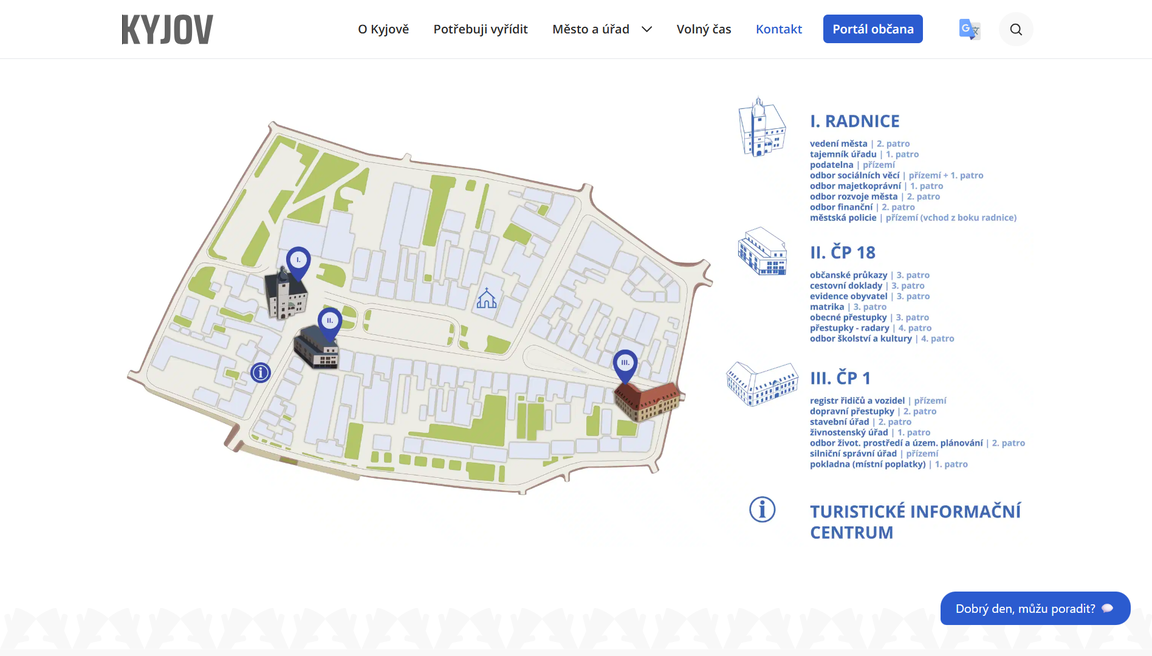
Offline orientation map
A unique tool for physical orientation between the three main office buildings scattered throughout the city.
Thanks to these innovations, the web finally functions as a two-way communication channel. While citizens appreciate intuitive tools in their pockets, administrators have the efficient Jarvis system in their hands, allowing them to work with data quickly and without errors.
Today, Kyjov's new website serves thousands of citizens and visitors to the city every month. It has fulfilled the goals that we defined together with the city at the beginning—to simplify access to information, lighten the workload of officials, and represent the city online in a dignified manner.
A few words from client
Our collaboration with DigiLabs pleasantly surprised us right from the start—we particularly appreciate the fact that the team did not come up with a ready-made solution, but really listened not only to the project management, but also to the office staff. The resulting website fulfilled everything we expected from the project and opened the way for us to further digital services.
The result of our work












Shall we have a chat?
If you have a project or collaboration that you would like to discuss with us, or if you are curious to hear more about how we can help you. We look forward to hearing from you.